On Location
London, and What Most Visitors Miss
London is a city that most visitors think they already know. The landmarks are so thoroughly documented — the Tower, the Palace, the Abbey, the Bridge — that arriving here can feel like revisiting somewhere familiar rather than discovering something new. That familiarity is the city’s greatest challenge and, for those who look past it, its greatest gift.
The London that rewards closer attention is not the London on the postcard. It’s the network of covered arcades off Piccadilly that have barely changed since the 1820s. It’s the Leadenhall Market in the early morning before the City fills. It’s Bermondsey on a Saturday for the antiques, and Maltby Street for the food. It’s the South Bank at dusk, walking west from Tower Bridge with the river on your right and the skyline assembling itself in the fading light.
That London is available to everyone. Most visitors never quite find it.
Where to Stay
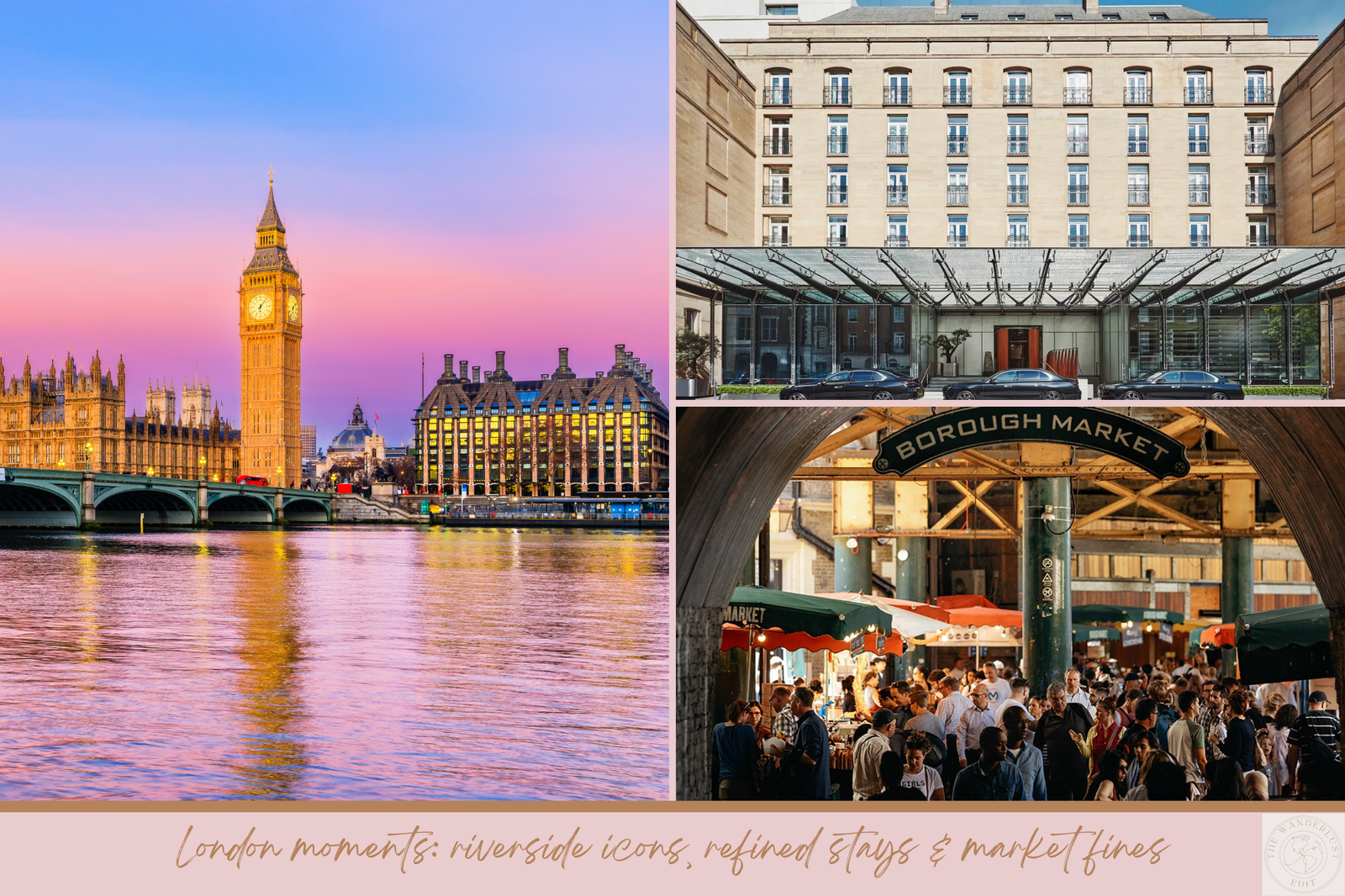
The Berkeley sits on the corner of Wilton Place in Knightsbridge — a short walk from Hyde Park, Harvey Nichols and the quieter streets of Belgravia that most visitors never reach. The rooftop pool, with its retractable roof and views across the London skyline, is one of the more unexpected pleasures in a city that doesn’t always wear its luxuries openly. The Berkeley Bar and Terrace, which opens onto the garden terrace, handles an aperitivo hour well.
For those who prefer Mayfair, Claridge’s on Brook Street remains the most authentically London of the grand hotels — the Art Deco interiors, the particular formality of the lobby, the afternoon tea service that has been drawing visitors since before any of us were born. It operates at a register that is entirely its own and earns its reputation consistently.
The Savoy on the Strand occupies a category of its own — the only hotel in London with a private entrance road, and a position overlooking the Thames that makes the river-facing rooms among the most desirable in the city. The American Bar is the oldest surviving cocktail bar in the UK and handles an evening well.
How to Spend the Time
Day One — Mayfair and the West End
Begin with Claridge’s for breakfast if you’re not staying there — the dining room is open to non-residents and the smoked salmon and scrambled eggs are precisely what a London morning should taste like. The Royal Academy on Piccadilly handles a morning well, particularly for major exhibitions. Burlington Arcade, immediately adjacent, is worth the detour — thirty-seven shops operating under Edwardian rules of conduct, including a prohibition on singing and hurrying, which is quietly restorative.
Lunch at Scott’s on Mount Street — one of London’s finest seafood restaurants, on Mount Street since 1967 and as good now as it has ever been. The afternoon in Mayfair: Heywood Hill bookshop on Curzon Street, the galleries around Cork Street, the particular quality of the streets between Grosvenor Square and Berkeley Square in the late afternoon. Dinner at Annabel’s or, for something quieter, Wiltons on Jermyn Street — established in 1742 and on Jermyn Street since 1984, one of the most enduring and quietly excellent dining rooms in London.
Day Two — The City and Southwark
The Tower of London and Tower Bridge are most rewarding with a Yeoman Warder tour, which provides historical context that makes the weight of the place land properly. Borough Market handles a late morning as well as anywhere in London — the best of British and international food producers in a Victorian covered market beneath the railway arches. Cross the river to Tate Modern, whose permanent collection is free and whose Turbine Hall installations are consistently the most ambitious contemporary art exhibitions in the country.
Dinner at Brat in Shoreditch — Michelin-starred, wood-fired cooking of exceptional quality, with a menu that changes daily and a room that rewards being in it. Book well in advance.
Day Three — Chelsea, Kensington and Notting Hill
The Victoria and Albert Museum is one of the world’s great collections and consistently underestimated by visitors who feel the Natural History Museum next door is the more obvious choice. The V&A is larger, more varied and contains things — the Cast Courts, the Raphael Cartoons, the jewellery and fashion galleries — that have no equivalent in any other museum. Give it a morning.
Lunch on the King’s Road, then north into Notting Hill: Portobello Road on a Saturday, Books for Cooks in Blenheim Crescent, the garden squares around Ladbroke Grove that feel a considerable distance from the rest of London. Dinner at The Ledbury on Ledbury Road — three Michelin stars, one of only a handful of restaurants in the UK to hold that distinction, and a room that is considerably warmer and less forbidding than the accolades might suggest. Worth every bit of the planning it requires.
A Note on London for International Visitors
London is one of the most logistically manageable cities in the world for the international visitor — English-speaking, well-connected by public transport, with an Oyster card that handles almost everything. The Heathrow Express from Terminal 5 to Paddington takes fifteen minutes and is worth the price over the Underground for those arriving with luggage. Taxis are reliable and the black cab drivers are among the most knowledgeable in any city in the world — the Knowledge, which requires years of study before qualification, produces guides who know every street, shortcut and building in Greater London.
Travelling with The Wanderlust Edit
Bookings at The Berkeley, Claridge’s or The Savoy arranged through The Wanderlust Edit may include preferred partner benefits such as a hotel or dining credit, complimentary daily breakfast, room upgrade on arrival where available, and early check-in and late checkout subject to availability. Benefits vary by property, room category, season and availability and will always be confirmed at the time of booking.
Every journey begins with a conversation.